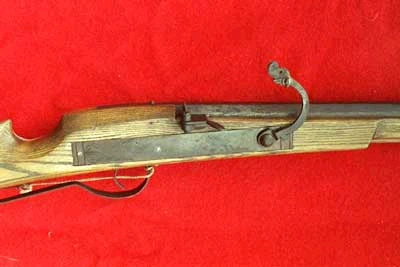
Side mechanics of a matchlock rifle.

Diagram showing a matchlock while being fired.
The matchlock mechanism, or just matchlock, was the first gunlock design. It was created in the mid-1400s, used in arquebuses. The matchlock was later partially replaced by the wheellock mechanism, before being fully replaced by the flintlock mechanism.
It used a piece similar to that of a striker (or hammer) called a serpentine, which held a slow-burning matchcord (slowmatch), which, after being lit burned slowly. The wielder would pull the trigger and the burning wick would be lowered into a flash pan, which contained gunpowder. After the powder was ignited, it created an explosion in the barrel, firing the projectile. Later in the 1540s, it was improved upon to include a cover plate over the flash pan, which automatically retracted when the trigger was pulled.
There were some major disadvantages to the matchlock, one being that the burning piece could easily fail to ignite in wet or freezing weather, and even lighting the cord takes an annoying amount of time, making it impractical and useless if the holder is put in a compromising situation, leading to the rise of the flintlock during the 1600s. However, the matchlock remained popular in the civilian market as it functioned just as well as a flintlock for most purposes, and it was significantly simpler, cheaper, and easier to maintain and produce than the flintlock. The immense surplus of matchlock material left within the market by the 1700s leading to a price drop made it very popular with rebels, militia, and civilians as well as poor militaries well into the mid 1800s, which saw the advent of bolt-action, breech-loading weapons such as the Chassepot.
Gallery


