The Pedersen device (officially the US Automatic Pistol, Caliber .30, Model of 1918[1]) was a drop-in conversion kit for the M1903 Springfield rifle.
Developed secretly during World War I, the kit allowed for its user to convert their rifle into "a form of submachine gun or automatic rifle" in a short time. Intended to be issued and used during the 1919 Spring Offensive which ultimately was never carried out, the devices were subsequently placed into storage and declared surplus in 1931.[2]
History
During World War I, a certain John Pedersen wanted to exponentially increase the firepower available to the average infantryman. To accomplish this, he drew up a design for his new device which was meant to be fitted into the standard service rifle for the time, the M1903 Springfield.
Pedersen traveled to Washington D.C. in October 1917 and conducted a secret demonstration of his new device to a selected group of infantrymen and congressmen, among which included Gen. William Crozier. He began by firing what appeared to be an unmodified M1903 Springfield; after firing off several rounds, he dropped in his conversion kit and fired off a few magazines, greatly impressing the evaluation team.[3]
In order to fool the enemy, the weapon was designated the US Automatic Pistol, Caliber .30, Model of 1918, with plans also drawn up to start production on these modified Springfields, official known as the US Rifle, Cal. .30, Model of M1903, Mark I.[4] In preparation for the 1919 Spring Offensive, the US Army placed orders for 133,450 devices and 800,000,000 .30-18 Auto cartridges, with Gen. John J. Pershing requesting 40 magazines and 5,000 rounds for use with each device and anticipated the use of 100 rounds on average per device.
Pedersen was paid USD 50,000 (approx. USD 747,208 in 2018 dollars) for the rights to produce the device; he was also paid fifty cents in royalties for each device manufactured. The US Army paid for all the necessary machinery required to produce the devices, with Remington receiving net profits of two dollars for each device and three cents for each magazine manufactured.
However, before the device could see any form of service, World War I ended, and as a result, the 1919 Spring Offensive never took place; as such, the reason for the device's production became completely irrelevant. Due to this, the contract to produce the device was canceled on 1 March 1919 after 65,000 devices, some 101,775 Springfield Mark Is, some 1,600,000 magazines and some 65,000,000 rounds;[5] despite that, production continued until 1920 in the event further conflicts arose.[6] As such, the remaining Pedersen devices were put into storage; the devices were later declared surplus in 1931, with most of them destroyed by fire as the project was still highly classified, along with the Army deciding that they did not want to pay for the cost of storage. Somewhere between 6 to 100 of these devices escaped destruction to become highly valuable collector's pieces.[2]
After their destruction, Maj Gen. Julian Hatcher wrote a detailed article about the device in a May 1932 issue of American Rifleman.
Design Details
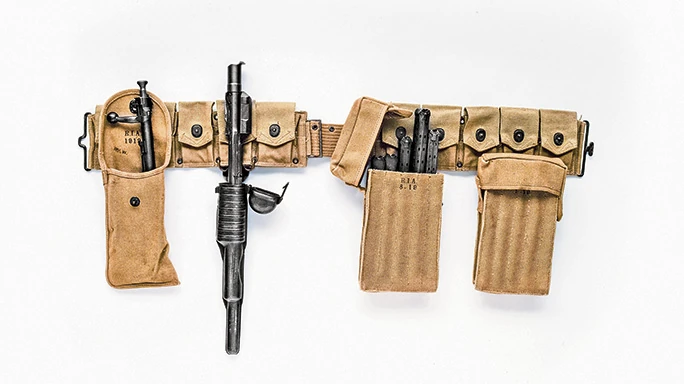

The Pedersen device's accoutrements belt.
Essentially a blowback pistol sans pistol grip,[7] the Pedersen device was a drop-in receiver for modified M1903 Springfield rifles, designated Mark Is. The weapon was fed by 40-round stick magazines with viewing holes cut into the rear, allowing the user to see how many unfed rounds were remaining. The device used the Springfield's trigger group, stock, sights and barrel (although the device itself had a short barrel itself the size of an M1906 .30-06 case) and ejected spent casings through a cutout on the side of the receiver.
To use the kit, all its user had to do was pull out the manually-operated bolt held in place by a small latch, drop in the device and they were ready. The device itself added 1.75 pounds (0.79 kilograms) to the weapon, although it allowed for about a 500% increase in rate of fire (trained soldiers could fire off two magazines (80 rounds) in less than a minute, compared to the ~15 rpm (sustained) of the Springfield). The magazine fed at a 45° angle, with spring-loaded "fingers" keeping the magazine in place.[5]
The weapon was supposed to complement the Browning Automatic Rifle and Thompson submachine gun. Users of the kit were given an accoutrements belt including a steel scabbard meant to hold the actual device itself, two large canvas pouches to hold five magazines and a small canvas pouch to hold the Springfield's turnbolt when not in use.[2] The scabbard was manufactured by Gorham Manufacturing Company while the pouches were manufactured by the Rock Island Arsenal. Remington apparently subcontracted Mt. Vernon Silversmiths to manufacture the magazines.[5]
Similar devices were also designed for the M1917 Enfield and the U.S. Rifle, 7.62 mm, Model of 1916 (Mosin-Nagant) known as the Mark II and Mark III respectively; neither entered production.[2] There may have also been a version planned for the Lebel Model 1886.
Ammunition
The rifle uses .30-18 Auto ammunition (officially known as the Auto Pistol Ball Cartridge Cal. 30 Model of 1918[5]), also known as 7.65×20mm Longue. The ammunition has a velocity of about 1,300 feet per second (400 metres per second).[8]
Gallery


References
- ↑ https://www.youtube.com/watch?v=znvzXr3cLD4
- ↑ 2.0 2.1 2.2 2.3 https://www.guns.com/news/2013/06/22/perishings-super-weapon-the-pedersen-device
- ↑ https://www.tactical-life.com/gear/trench-warrior-pedersen-device/
- ↑ https://youtu.be/wLzdGPzHL8U
- ↑ 5.0 5.1 5.2 5.3 https://www.americanrifleman.org/articles/2016/10/18/never-in-anger-the-pedersen-device/
- ↑ http://rockislandauction.blogspot.com/2013/03/the-pedersen-device.html
- ↑ https://www.youtube.com/watch?v=9WgMD92jz1o
- ↑ https://www.fieldandstream.com/blast-from-past-pedersen-device